Clavicle
Clavicula
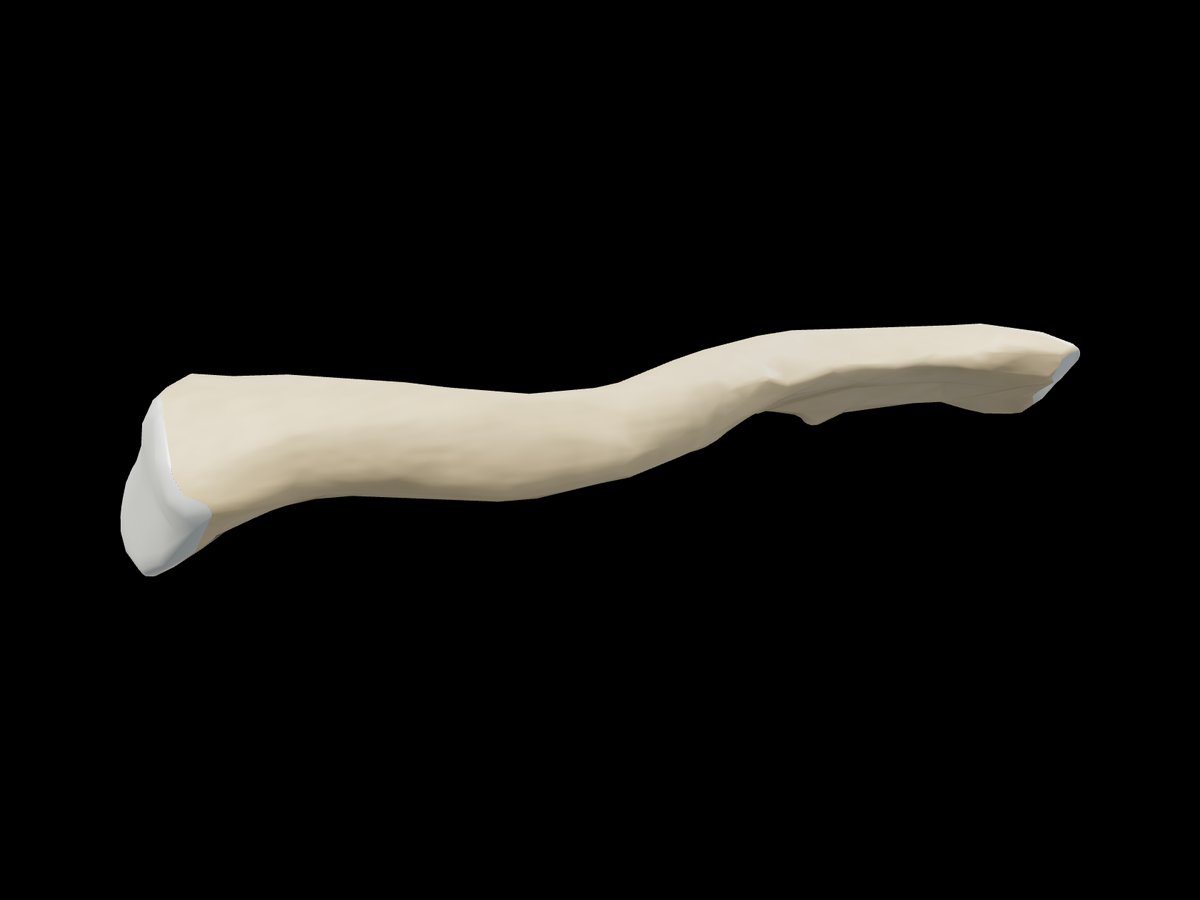
The clavicle (collarbone) is an S-shaped long bone lying horizontally at the root of the neck. It acts as a strut that holds the upper limb away from the trunk, so the arm can swing freely, and it is the only bony link between the upper limb and the axial skeleton.
Other names: Clavicula (Latin) · Clavicule (French) · Clavícula (Spanish, Portuguese)
Key facts
- Type
- Long bone (atypical: no medullary cavity, ossifies largely in membrane)
- Arterial supply
- Suprascapular and thoraco-acromial arteries
- Articulations
- Sternoclavicular joint (saddle-type synovial joint with an articular disc) medially; acromioclavicular joint (plane synovial joint) laterally
- Ossification
- The first bone to ossify, from two primary centres in the shaft in the 5th–6th week of fetal life (largely intramembranous). A secondary centre at the sternal end appears at about 18–20 years and fuses by about 25 years; it is one of the last epiphyses to fuse
- Function
- A strut that holds the shoulder out from the trunk and passes forces from the upper limb to the axial skeleton; it anchors deltoid, trapezius, pectoralis major and sternocleidomastoid, and shields the vessels and nerves below it
Location and relations
Subcutaneous along its whole length, between the manubrium of the sternum medially and the acromion of the scapula laterally. The medial two-thirds are convex forwards; the lateral third is concave forwards and flattened. Below it run the subclavius muscle, the subclavian vessels and the brachial plexus.
Parts and features
- Sternal (medial) end: large, triangular, articulates with the manubrium and first costal cartilage
- Acromial (lateral) end: flat, with a small oval facet for the acromion
- Shaft: rounded medially, flattened laterally
- Conoid tubercle and trapezoid line on the inferior surface of the lateral third, for the coracoclavicular ligament
- Impression for the costoclavicular ligament near the medial end; groove for subclavius on the inferior surface
Surface anatomy
The whole bone can be felt and traced from the jugular notch to the acromion; the acromioclavicular joint is felt as a small step at its lateral end.
Landmarks on the clavicle
- Acromial end
- Acromial facet
- Body of clavicle
- Conoid tubercle
- Groove for subclavius muscle
- Impression for costoclavicular ligament
- Sternal articular surface
- Sternal end
- Trapezoid line
- Tuberosity for coracoclavicular ligament
Muscles attached to the clavicle
Origins
- Clavicular head of pectoralis major muscle
- Clavicular part of deltoid muscle
- Sternocleidomastoid muscle
- Sternohyoid muscle
Insertions
Clinical notes
- One of the most commonly fractured bones, usually at the junction of the middle and lateral thirds after a fall on the outstretched hand or the shoulder; the medial fragment is pulled up by sternocleidomastoid and the lateral fragment down by the weight of the arm
- Acromioclavicular joint separation ("shoulder separation") follows a direct blow to the point of the shoulder; tearing of the coracoclavicular ligament lets the clavicle ride high
- Congenital absence or underdevelopment occurs in cleidocranial dysplasia, which allows the shoulders to be brought together in front of the chest
Quick answers
Where is the clavicle located?
Subcutaneous along its whole length, between the manubrium of the sternum medially and the acromion of the scapula laterally. The medial two-thirds are convex forwards; the lateral third is concave forwards and flattened. Below it run the subclavius muscle, the subclavian vessels and the brachial plexus.
What does the clavicle articulate with?
Sternoclavicular joint (saddle-type synovial joint with an articular disc) medially; acromioclavicular joint (plane synovial joint) laterally
When does the clavicle ossify?
The first bone to ossify, from two primary centres in the shaft in the 5th–6th week of fetal life (largely intramembranous). A secondary centre at the sternal end appears at about 18–20 years and fuses by about 25 years; it is one of the last epiphyses to fuse
What is the blood supply of the clavicle?
Suprascapular and thoraco-acromial arteries
What does the clavicle do?
A strut that holds the shoulder out from the trunk and passes forces from the upper limb to the axial skeleton; it anchors deltoid, trapezius, pectoralis major and sternocleidomastoid, and shields the vessels and nerves below it
Notes written for anatmy3d and checked against Gray’s Anatomy, Moore’s Clinically Oriented Anatomy and Netter. Last reviewed .