Eleventh rib
Undecima costa
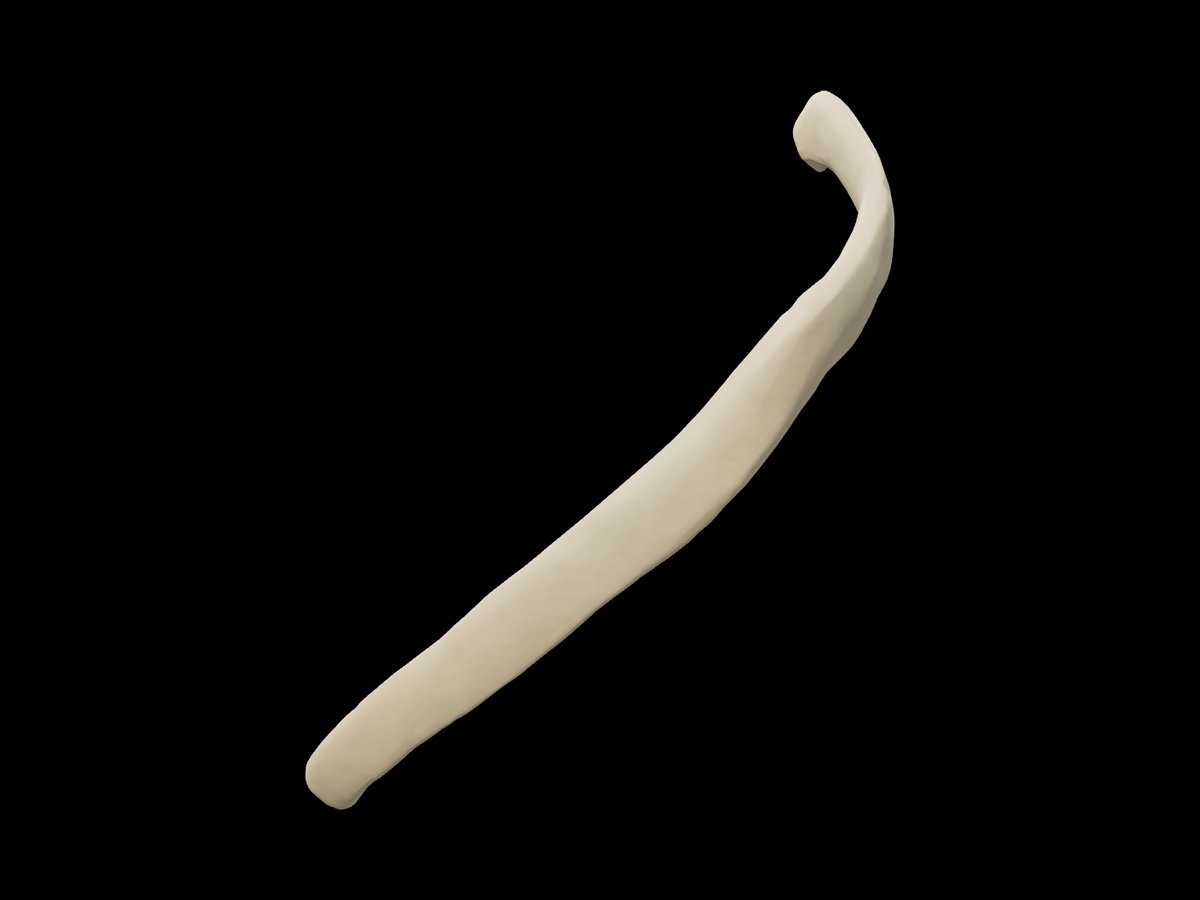
The eleventh rib is a floating rib: it has no anterior attachment, ending freely in the muscles of the abdominal wall. It is short, with a single facet on its head and no tubercle.
Other names: Undecima costa (Latin) · Onzième côte (French) · Undécima costilla (Spanish) · Décima primeira costela (Portuguese)
Key facts
- Type
- Flat bone (atypical rib)
- Nerve supply
- Eleventh intercostal nerve
- Arterial supply
- Eleventh posterior intercostal artery
- Articulations
- T11 vertebral body only
- Ligaments
- Radiate ligament of the head
- Ossification
- Primary centre in the fetal period; one secondary centre for the head at puberty
- Function
- A floating rib with no front attachment, so it moves freely with the abdominal wall; it protects the kidney and, on the left, the spleen, and anchors the diaphragm, latissimus dorsi and the oblique muscles
Location and relations
Lower posterolateral chest wall, overlying the kidney and, on the left, the spleen.
Parts and features
- Head with a single facet for T11
- No neck or tubercle facet
- Short shaft with a faint costal groove and a pointed cartilaginous tip
Surface anatomy
Its tip can be felt in the flank.
Landmarks on the eleventh rib
- Angle of rib
- Articular facet of head of rib
- Body of rib
- Costal groove
- Head of rib
Muscles attached to the eleventh rib
Origins
Insertions
Clinical notes
- Fractures of the eleventh and twelfth ribs may injure the kidney or spleen
- Flank incisions for kidney surgery often pass along the eleventh or twelfth rib
Quick answers
Where is the eleventh rib located?
Lower posterolateral chest wall, overlying the kidney and, on the left, the spleen.
What does the eleventh rib articulate with?
T11 vertebral body only
When does the eleventh rib ossify?
Primary centre in the fetal period; one secondary centre for the head at puberty
What is the blood supply of the eleventh rib?
Eleventh posterior intercostal artery
What does the eleventh rib do?
A floating rib with no front attachment, so it moves freely with the abdominal wall; it protects the kidney and, on the left, the spleen, and anchors the diaphragm, latissimus dorsi and the oblique muscles
Notes written for anatmy3d and checked against Gray’s Anatomy, Moore’s Clinically Oriented Anatomy and Netter. Last reviewed .