BonesBones of the free part of the upper limb
Ulna
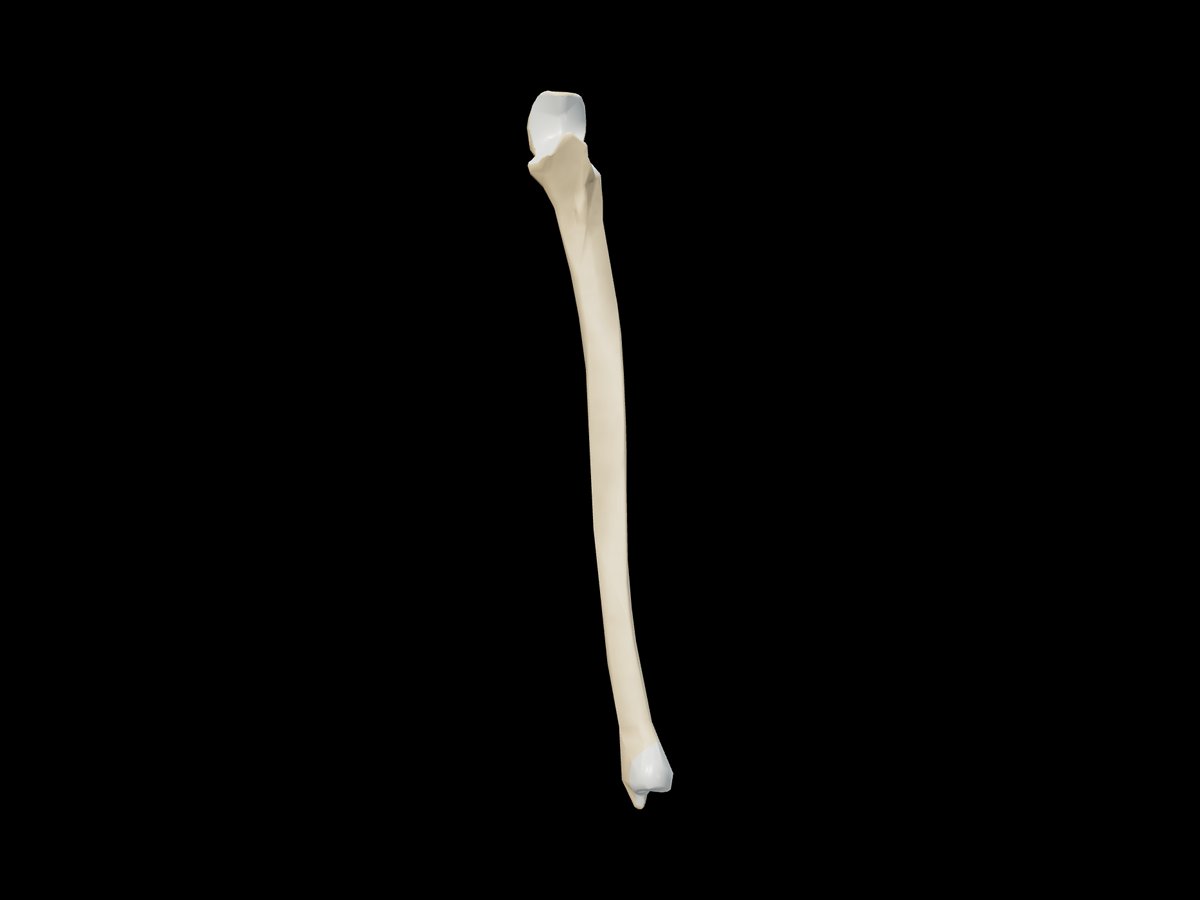
The ulna is the medial bone of the forearm, on the little-finger side. It is the stabilising bone of the forearm: wide and hooked at the elbow, where it grips the trochlea of the humerus, and narrow at the wrist.
Key facts
- Type
- Long bone
- Arterial supply
- Nutrient artery from the anterior interosseous artery
- Articulations
- Humero-ulnar part of the elbow joint; proximal and distal radio-ulnar joints. At the wrist the head is separated from the carpus by the articular disc (triangular fibrocartilage)
- Ligaments
- Ulnar collateral ligament of the elbow, annular ligament (attached to the margins of the radial notch), interosseous membrane, triangular fibrocartilage complex
- Ossification
- Primary centre in the shaft at the 8th fetal week; secondary centres in the lower end (about 5–6 years) and olecranon (about 9–10 years). The olecranon fuses at about 16 and the lower end at about 18–20 years
- Function
- The forearm's stable axis: its trochlear notch forms the elbow hinge, the olecranon is the lever for triceps and brachialis inserts just below the coronoid process; the radius turns around it
Location and relations
Runs from the elbow to the wrist medial to the radius, joined to it by the interosseous membrane. Its posterior border is subcutaneous along its whole length.
Parts and features
- Olecranon: the point of the elbow, receiving the triceps tendon
- Coronoid process: projects forwards below the trochlear notch; the brachialis inserts on the ulnar tuberosity just below it
- Trochlear notch: the large concave surface that articulates with the trochlea of the humerus
- Radial notch: on the lateral side of the coronoid process, for the head of the radius
- Shaft: triangular, with a sharp interosseous border facing the radius and a subcutaneous posterior border
- Lower end: small rounded head and the ulnar styloid process
Surface anatomy
The olecranon and the whole posterior border can be felt; the head makes a rounded bump on the back of the wrist on the little-finger side, with the styloid process just below it.
Landmarks on the ulna
- Anterior border of ulna
- Articular circumference of head of ulna
- Body of ulna
- Coronoid process of ulnaprojects forwards below the trochlear notch; the brachialis inserts on the ulnar tuberosity just below it
- Head of ulna
- Interosseous border of ulna
- Medial surface of ulna
- Olecranonthe point of the elbow, receiving the triceps tendon
- Posterior border of ulna
- Posterior surface of ulna
- Radial notchon the lateral side of the coronoid process, for the head of the radius
- Sublime tubercle
- Supinator crest
- Trochlear notchthe large concave surface that articulates with the trochlea of the humerus
- Tuberosity of ulna
- Ulnar styloid process
Muscles attached to the ulna
Origins
- Abductor pollicis longus
- Deep head of pronator teres
- Extensor indicis
- Extensor pollicis longus
- Flexor digitorum profundus
- Flexor pollicis longus
- Humero-ulnar head of flexor digitorum superficialis
- Pronator quadratus
- Supinator
- Ulnar head of extensor carpi ulnaris
- Ulnar head of flexor carpi ulnaris
Insertions
Clinical notes
- Monteggia fracture: a fracture of the upper third of the ulna with dislocation of the radial head
- Olecranon fractures from falls on the point of the elbow may be pulled apart by triceps
- A "nightstick" fracture of the shaft occurs when the forearm is raised to ward off a blow
- The ulnar nerve passes behind the medial epicondyle and into the forearm close to the ulna; it is at risk in elbow injuries
Quick answers
Where is the ulna located?
Runs from the elbow to the wrist medial to the radius, joined to it by the interosseous membrane. Its posterior border is subcutaneous along its whole length.
What does the ulna articulate with?
Humero-ulnar part of the elbow joint; proximal and distal radio-ulnar joints. At the wrist the head is separated from the carpus by the articular disc (triangular fibrocartilage)
When does the ulna ossify?
Primary centre in the shaft at the 8th fetal week; secondary centres in the lower end (about 5–6 years) and olecranon (about 9–10 years). The olecranon fuses at about 16 and the lower end at about 18–20 years
What is the blood supply of the ulna?
Nutrient artery from the anterior interosseous artery
What does the ulna do?
The forearm's stable axis: its trochlear notch forms the elbow hinge, the olecranon is the lever for triceps and brachialis inserts just below the coronoid process; the radius turns around it
Notes written for anatmy3d and checked against Gray’s Anatomy, Moore’s Clinically Oriented Anatomy and Netter. Last reviewed .