Vertebra L5
Vertebra lumborum V
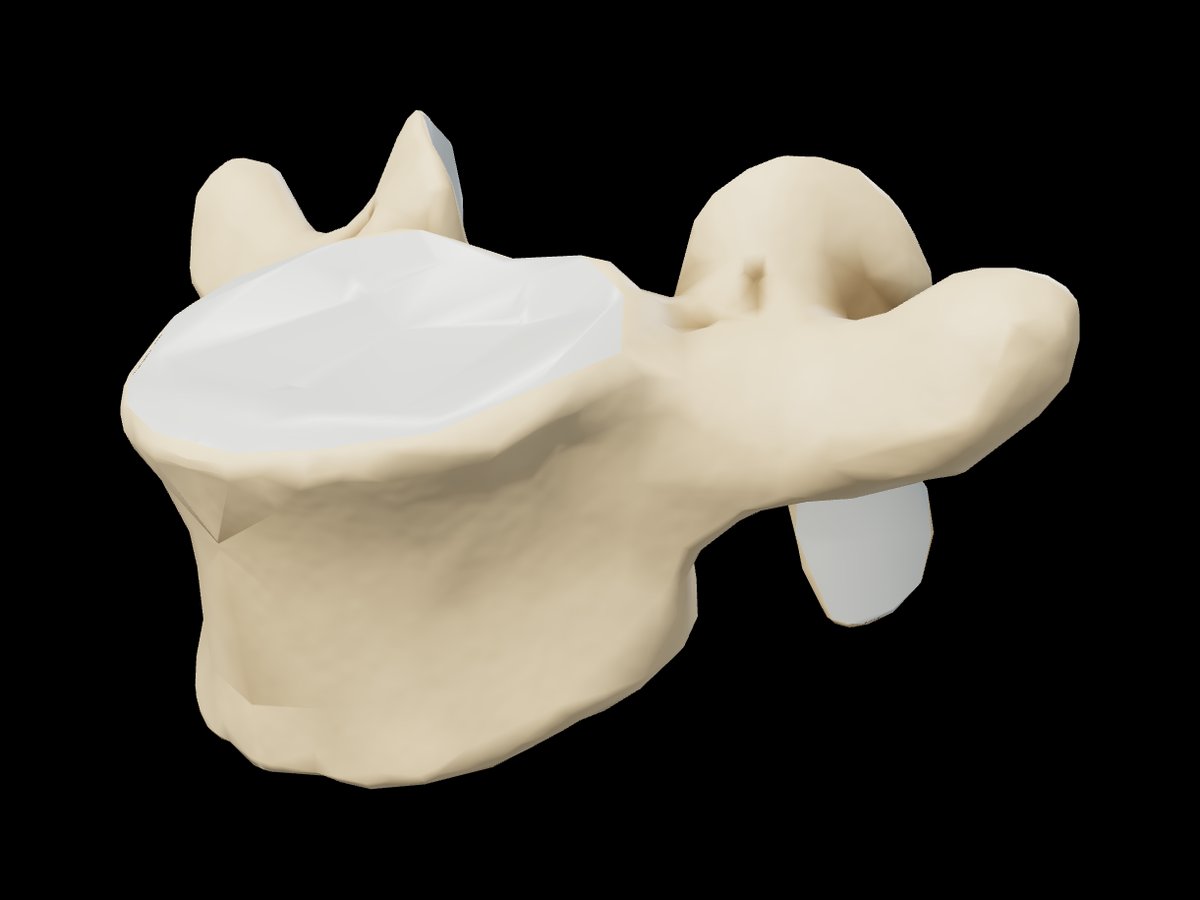
The fifth lumbar vertebra is the largest vertebra and the lowest mobile one. Its body is wedge-shaped, taller in front, which creates the angle between the lumbar spine and the sacrum (lumbosacral angle).
Other names: Vertebra lumborum V (Latin) · Vertèbre L5 (French) · Vértebra L5 (Spanish, Portuguese)
Key facts
- Type
- Irregular bone (atypical lumbar vertebra)
- Nerve supply
- The L5 nerve exits below it (great-toe extension, skin of the top of the foot)
- Arterial supply
- Lumbar and iliolumbar arteries
- Articulations
- L4 above; sacrum below (lumbosacral joint with the L5–S1 disc)
- Ligaments
- Iliolumbar ligaments, lumbosacral ligaments, anterior and posterior longitudinal ligaments
- Ossification
- As for a typical lumbar vertebra
- Function
- The lowest mobile vertebra: its wedge-shaped body sets the lumbosacral angle and passes the whole upper body's weight to the sacrum, while strong iliolumbar ligaments tie its thick transverse processes to the iliac crest
Location and relations
At the base of the lumbar spine, resting on the sacrum at the lumbosacral joint.
Parts and features
- Massive body, taller in front than behind
- Short, thick transverse processes joined to the body as well as the pedicles, attached to the iliac crest by the iliolumbar ligament
- Smaller spinous process
- Pars interarticularis between the superior and inferior articular processes
Surface anatomy
Spinous process lies just below the iliac crest line, in a slight hollow above the sacrum.
Landmarks on the vertebra L5
- Annular epiphysis
- Costal part of transverse process
- Inferior articular facet of vertebra
- Inferior articular process of vertebra
- Inferior vertebral notch
- Intervertebral foramen
- Intervertebral surface
- Lamina of vertebral arch
- Lateral part of transverse process
- Pars interarticularis of vertebral arch
- Pedicle of vertebral arch
- Spinous process
- Superior articular facet of vertebra
- Superior articular process of vertebra
- Superior vertebral notch
- Transverse process
- Vertebral arch
- Vertebral body
- Vertebral foramen
Muscles attached to the vertebra L5
Origins
Clinical notes
- Spondylolysis: a stress fracture of the pars interarticularis, common in young gymnasts and fast bowlers; it can allow L5 to slip forwards on the sacrum (spondylolisthesis)
- L5–S1 is, with L4–L5, the commonest site of disc herniation, usually compressing the S1 root (calf weakness, loss of the ankle reflex, pain down the back of the leg)
- Sacralisation (L5 fused to the sacrum) and lumbarisation (S1 separate) are common transitional variants that can cause miscounting
Quick answers
Where is the vertebra L5 located?
At the base of the lumbar spine, resting on the sacrum at the lumbosacral joint.
What does the vertebra L5 articulate with?
L4 above; sacrum below (lumbosacral joint with the L5–S1 disc)
When does the vertebra L5 ossify?
As for a typical lumbar vertebra
What is the blood supply of the vertebra L5?
Lumbar and iliolumbar arteries
What does the vertebra L5 do?
The lowest mobile vertebra: its wedge-shaped body sets the lumbosacral angle and passes the whole upper body's weight to the sacrum, while strong iliolumbar ligaments tie its thick transverse processes to the iliac crest
Notes written for anatmy3d and checked against Gray’s Anatomy, Moore’s Clinically Oriented Anatomy and Netter. Last reviewed .