Vertebra C7
Vertebra cervicalis VII
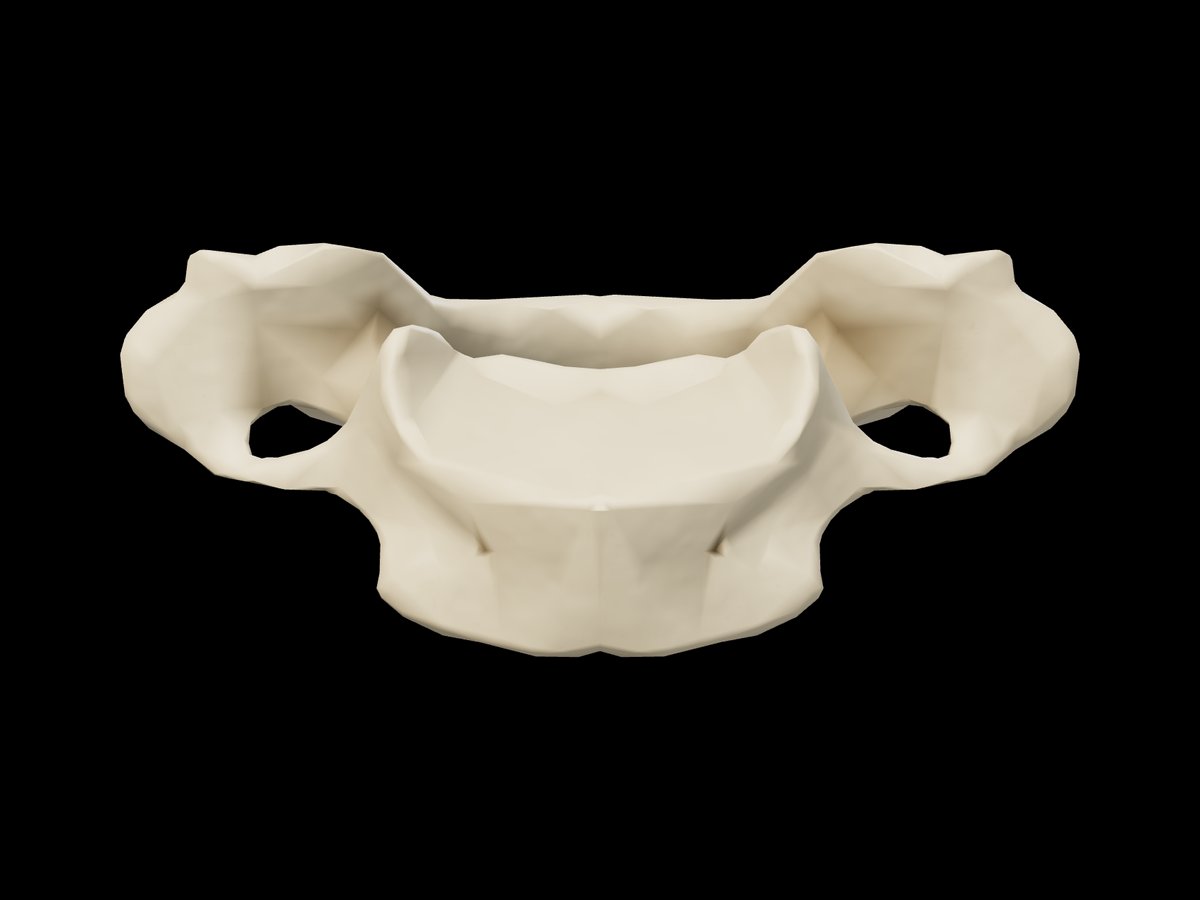
The seventh cervical vertebra (vertebra prominens) has a long, non-bifid spinous process that is easy to see and feel at the base of the neck. It marks the transition between the cervical and thoracic spine.
Other names: Vertebra cervicalis VII (Latin) · Vertèbre C7 (French) · Vértebra C7 (Spanish, Portuguese)
Key facts
- Type
- Irregular bone (atypical cervical vertebra)
- Nerve supply
- The C7 nerve exits above it and the C8 nerve below it (there are eight cervical nerves but seven cervical vertebrae)
- Arterial supply
- Vertebral and deep cervical artery branches
- Articulations
- C6 and T1 (discs and facet joints)
- Ligaments
- Ligamentum nuchae, supraspinous ligament, ligamenta flava
- Ossification
- As for a typical cervical vertebra; the costal element of the transverse process can grow into a cervical rib
- Function
- Its long spinous process anchors the ligamentum nuchae, trapezius and other back muscles at the cervicothoracic junction; its small foramina transversaria usually carry only veins, not the vertebral artery
Location and relations
At the root of the neck, just above the first thoracic vertebra.
Parts and features
- Body larger than the other cervical vertebrae
- Long, single (not bifid) spinous process ending in a tubercle for the ligamentum nuchae
- Transverse processes with small foramina transversaria that usually transmit only veins, not the vertebral artery
Surface anatomy
The most prominent spinous process at the base of the neck; it moves forwards with neck extension, unlike T1 below it.
Landmarks on the vertebra C7
- Anterior tubercle of transverse process
- Foramen transversarium
- Groove for spinal nerve
- Inferior articular facet of vertebra
- Inferior articular process of vertebra
- Lamina of vertebral arch
- Pedicle of vertebral arch
- Posterior tubercle of transverse process
- Spinous process
- Superior articular facet of vertebra
- Superior articular process of vertebra
- Transverse process
- Uncinate process of vertebra
- Vertebral body
- Vertebral foramen
Muscles attached to the vertebra C7
Origins
Clinical notes
- A cervical rib from C7 (in about 1 in 200 people) can compress the brachial plexus or subclavian artery (thoracic outlet syndrome)
- C7 is the starting point for counting spinous processes down the back
Quick answers
Where is the vertebra C7 located?
At the root of the neck, just above the first thoracic vertebra.
What does the vertebra C7 articulate with?
C6 and T1 (discs and facet joints)
When does the vertebra C7 ossify?
As for a typical cervical vertebra; the costal element of the transverse process can grow into a cervical rib
What is the blood supply of the vertebra C7?
Vertebral and deep cervical artery branches
What does the vertebra C7 do?
Its long spinous process anchors the ligamentum nuchae, trapezius and other back muscles at the cervicothoracic junction; its small foramina transversaria usually carry only veins, not the vertebral artery
Notes written for anatmy3d and checked against Gray’s Anatomy, Moore’s Clinically Oriented Anatomy and Netter. Last reviewed .