Vertebra C3
Vertebra cervicalis III
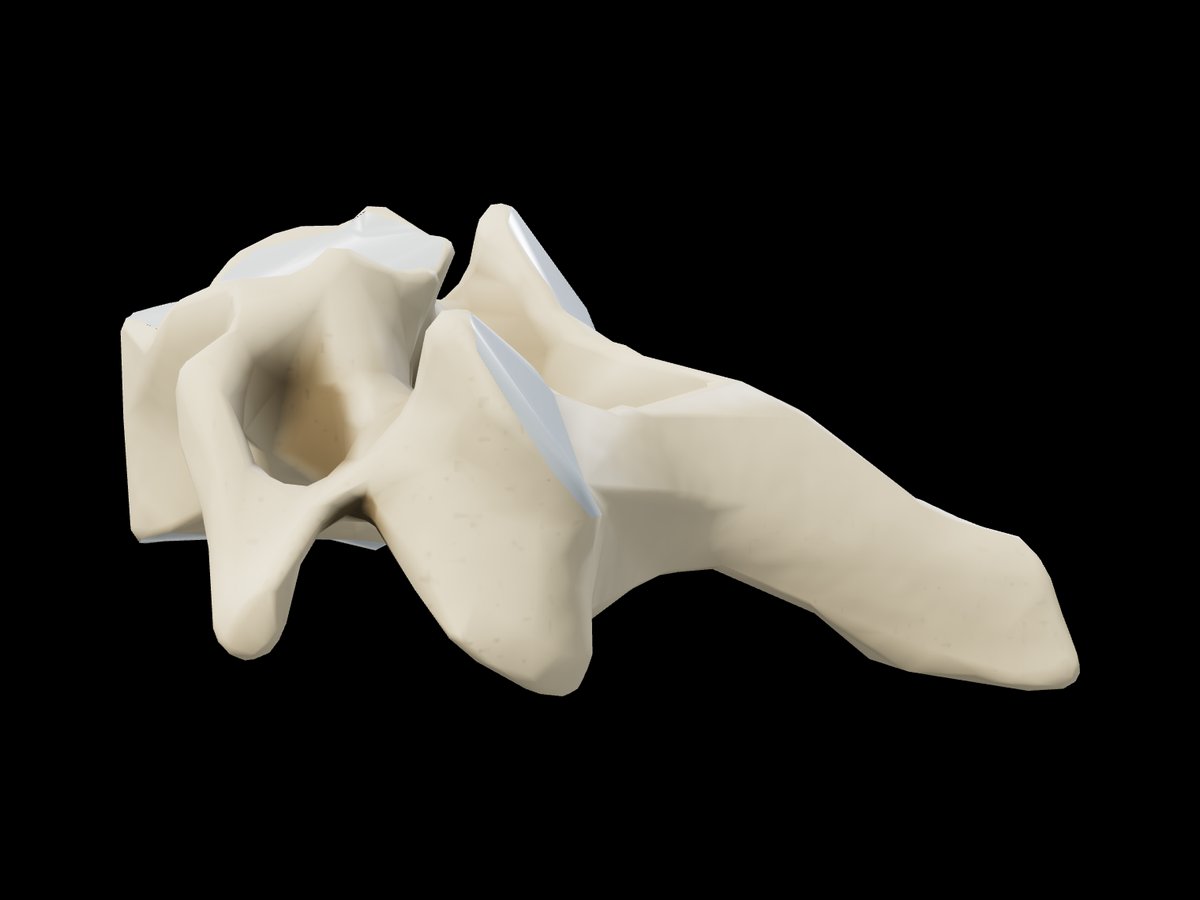
The third cervical vertebra is a typical cervical vertebra: a small, wide body, a large triangular vertebral foramen, foramina in the transverse processes for the vertebral arteries and a short bifid spinous process.
Other names: Vertebra cervicalis III (Latin) · Vertèbre C3 (French) · Vértebra C3 (Spanish, Portuguese)
Key facts
- Type
- Irregular bone (typical cervical vertebra)
- Nerve supply
- The C3 spinal nerve leaves above it, the C4 nerve below it (cervical nerves exit above the vertebra of the same number)
- Arterial supply
- Vertebral and ascending cervical artery branches
- Articulations
- C2 and C4 (intervertebral discs, uncovertebral joints and facet joints)
- Ligaments
- Anterior and posterior longitudinal ligaments, ligamenta flava, interspinous ligaments, ligamentum nuchae
- Ossification
- Three primary centres (body and two halves of the arch) in the fetal period; arches fuse behind at about 1–3 years and with the body at about 3–6 years; secondary centres at puberty, fusing by about 25
- Function
- Carries the head's weight through its small body and discs while its arch encloses the spinal cord; its foramina transversaria transmit the vertebral arteries, and the C3 and C4 nerves (phrenic roots) leave above and below it
Location and relations
Mid-upper neck, at about the level of the hyoid bone.
Parts and features
- Small oval body with raised lateral lips (uncinate processes) on its upper surface
- Large triangular vertebral foramen for the cervical enlargement of the spinal cord
- Transverse processes with foramina transversaria and anterior and posterior tubercles
- Superior and inferior articular processes with facets facing up-back and down-forwards
- Short bifid spinous process
Surface anatomy
Its spinous process is short and lies deep to the ligamentum nuchae; the vertebral body lies at the level of the hyoid.
Landmarks on the vertebra C3
- Anterior tubercle of transverse process
- Foramen transversarium
- Groove for spinal nerve
- Inferior articular facet of vertebra
- Inferior articular process of vertebra
- Lamina of vertebral arch
- Pedicle of vertebral arch
- Posterior tubercle of transverse process
- Spinous process
- Superior articular facet of vertebra
- Superior articular process of vertebra
- Transverse process
- Uncinate process of vertebra
- Vertebral body
- Vertebral foramen
Muscles attached to the vertebra C3
Origins
Clinical notes
- C3, C4 and C5 keep the diaphragm alive: spinal cord injury at or above this level can stop breathing
Quick answers
Where is the vertebra C3 located?
Mid-upper neck, at about the level of the hyoid bone.
What does the vertebra C3 articulate with?
C2 and C4 (intervertebral discs, uncovertebral joints and facet joints)
When does the vertebra C3 ossify?
Three primary centres (body and two halves of the arch) in the fetal period; arches fuse behind at about 1–3 years and with the body at about 3–6 years; secondary centres at puberty, fusing by about 25
What is the blood supply of the vertebra C3?
Vertebral and ascending cervical artery branches
What does the vertebra C3 do?
Carries the head's weight through its small body and discs while its arch encloses the spinal cord; its foramina transversaria transmit the vertebral arteries, and the C3 and C4 nerves (phrenic roots) leave above and below it
Notes written for anatmy3d and checked against Gray’s Anatomy, Moore’s Clinically Oriented Anatomy and Netter. Last reviewed .