Axis (C2)
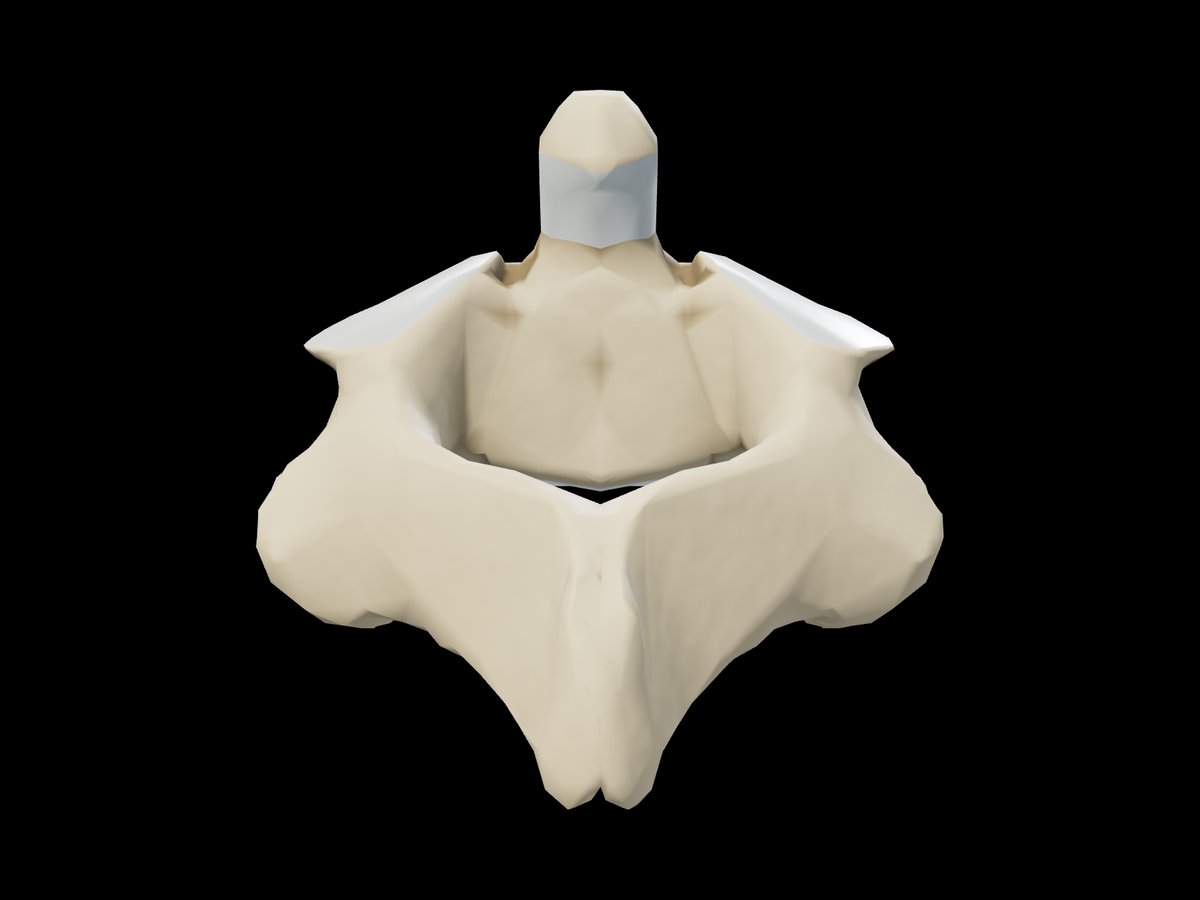
The axis is the second cervical vertebra. Its tooth-like dens projects up through the ring of the atlas and acts as the pivot around which the head turns from side to side.
Other names: Áxis (C2) (Portuguese)
Key facts
- Type
- Irregular bone (atypical cervical vertebra)
- Arterial supply
- Vertebral artery branches; the dens has a relatively poor blood supply at its base
- Articulations
- Atlas (median atlanto-axial pivot joint and lateral atlanto-axial joints); C3 (intervertebral disc and facet joints)
- Ligaments
- Transverse ligament of the atlas, alar ligaments (dens to the skull), apical ligament, tectorial membrane
- Movements
- Atlanto-axial joints allow about half of all neck rotation (the "no" movement)
- Ossification
- Five primary centres (body, two for the dens, two for the neural arches) plus a secondary centre at the tip of the dens; the dens fuses with the body at about 3–6 years
- Function
- Its dens is the pivot around which the atlas and skull turn (about half of neck rotation), held by the transverse and alar ligaments; its large spinous process anchors rectus capitis posterior major and obliquus capitis inferior
Location and relations
In the upper neck, below the atlas and above C3; its large spinous process is the first one easily felt below the skull.
Parts and features
- Dens (odontoid process): an upward peg, the "missing" body of the atlas
- Body below the dens
- Large superior articular facets for the atlas
- Thick, bifid spinous process
- Transverse processes with foramina transversaria
Surface anatomy
Its spinous process is the first prominent bump in the midline below the occipital bone.
Landmarks on the axis (C2)
- Anterior articular facet of dens axis
- Apex of dens axis
- Dens axis
- Posterior articular facet of dens axis
Muscles attached to the axis (C2)
Origins
Insertions
Clinical notes
- Odontoid (dens) fractures are common in elderly people after falls; fractures at the base of the dens may not heal
- Hangman's fracture: bilateral fracture of the pars interarticularis from forceful hyperextension
- Atlanto-axial instability (rheumatoid arthritis, Down syndrome) can compress the cord
Quick answers
Where is the axis (C2) located?
In the upper neck, below the atlas and above C3; its large spinous process is the first one easily felt below the skull.
What does the axis (C2) articulate with?
Atlas (median atlanto-axial pivot joint and lateral atlanto-axial joints); C3 (intervertebral disc and facet joints)
When does the axis (C2) ossify?
Five primary centres (body, two for the dens, two for the neural arches) plus a secondary centre at the tip of the dens; the dens fuses with the body at about 3–6 years
What is the blood supply of the axis (C2)?
Vertebral artery branches; the dens has a relatively poor blood supply at its base
What does the axis (C2) do?
Its dens is the pivot around which the atlas and skull turn (about half of neck rotation), held by the transverse and alar ligaments; its large spinous process anchors rectus capitis posterior major and obliquus capitis inferior
Notes written for anatmy3d and checked against Gray’s Anatomy, Moore’s Clinically Oriented Anatomy and Netter. Last reviewed .