Vertebra C4
Vertebra cervicalis IV
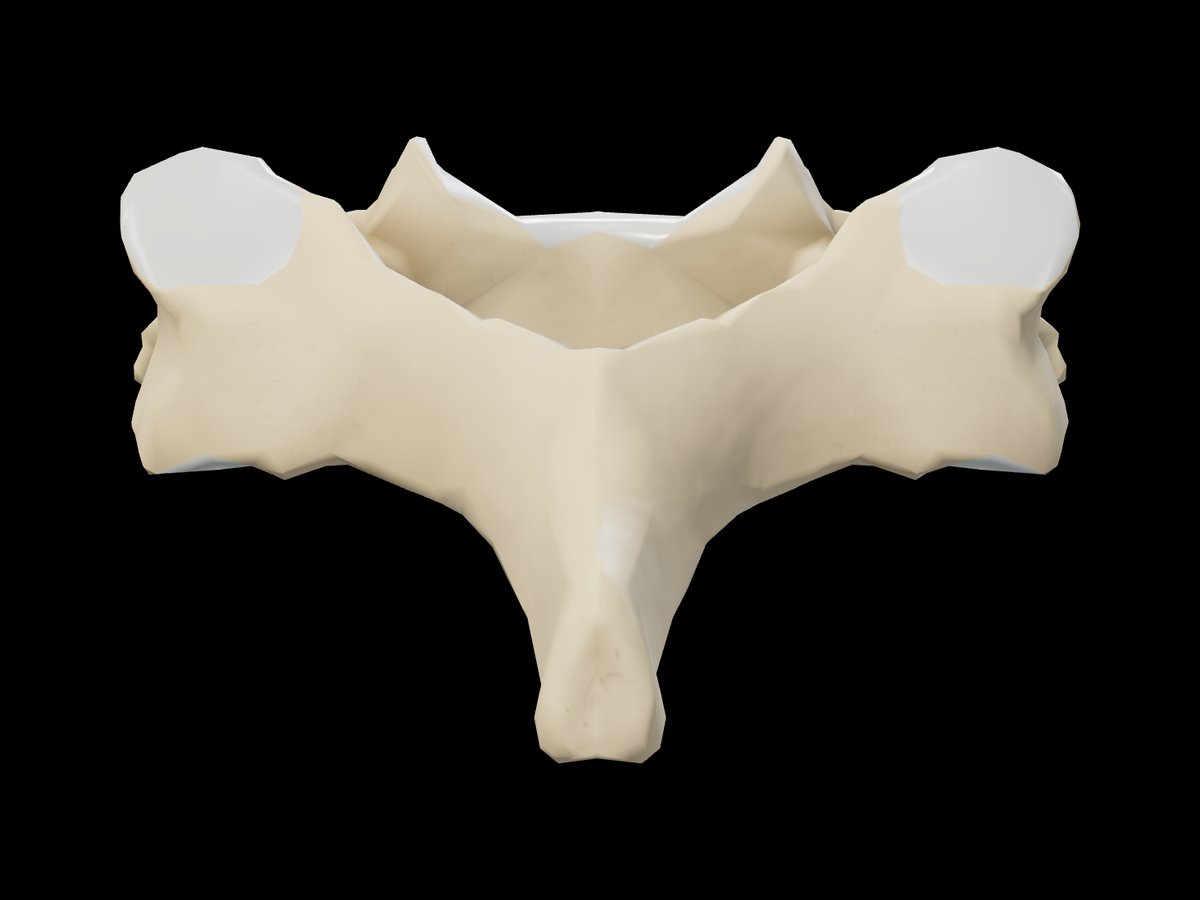
The fourth cervical vertebra is a typical cervical vertebra. The carotid artery divides at about its level, at the upper border of the thyroid cartilage.
Other names: Vertebra cervicalis IV (Latin) · Vertèbre C4 (French) · Vértebra C4 (Spanish, Portuguese)
Key facts
- Type
- Irregular bone (typical cervical vertebra)
- Nerve supply
- The C4 spinal nerve exits above it; C4 contributes to the phrenic nerve and supplies the skin over the top of the shoulder
- Arterial supply
- Vertebral and ascending cervical artery branches
- Articulations
- C3 and C5 (discs, uncovertebral and facet joints)
- Ligaments
- Anterior and posterior longitudinal ligaments, ligamenta flava, ligamentum nuchae
- Ossification
- As for a typical cervical vertebra: three primary centres, fused by about 6 years; secondary centres at puberty
- Function
- Its small body and discs bear the head's weight and its facet joints allow free flexion, extension and rotation; the arch shields the cervical cord, and levator scapulae and scalenus anterior arise from its transverse processes
Location and relations
Mid-neck, at the level of the upper border of the thyroid cartilage.
Parts and features
- Small wide body with uncinate processes
- Large triangular vertebral foramen
- Transverse processes with foramina transversaria
- Short bifid spinous process
Surface anatomy
Level of the upper border of the thyroid cartilage (the bifurcation of the common carotid artery).
Landmarks on the vertebra C4
- Anterior tubercle of transverse process
- Cervical vertebra
- Foramen transversarium
- Groove for spinal nerve
- Inferior articular facet of vertebra
- Inferior articular process of vertebra
- Lamina of vertebral arch
- Pedicle of vertebral arch
- Posterior tubercle of transverse process
- Spinous process
- Superior articular facet of vertebra
- Superior articular process of vertebra
- Transverse process
- Uncinate process of vertebra
- Vertebral body
- Vertebral foramen
Muscles attached to the vertebra C4
Origins
Insertions
Clinical notes
- Cervical spondylosis (wear of discs and facet joints) commonly affects C4–C7, narrowing the foramina and pressing on nerve roots
Quick answers
Where is the vertebra C4 located?
Mid-neck, at the level of the upper border of the thyroid cartilage.
What does the vertebra C4 articulate with?
C3 and C5 (discs, uncovertebral and facet joints)
When does the vertebra C4 ossify?
As for a typical cervical vertebra: three primary centres, fused by about 6 years; secondary centres at puberty
What is the blood supply of the vertebra C4?
Vertebral and ascending cervical artery branches
What does the vertebra C4 do?
Its small body and discs bear the head's weight and its facet joints allow free flexion, extension and rotation; the arch shields the cervical cord, and levator scapulae and scalenus anterior arise from its transverse processes
Notes written for anatmy3d and checked against Gray’s Anatomy, Moore’s Clinically Oriented Anatomy and Netter. Last reviewed .